Research Fundamentals with AI Agents: An Introduction to the Series
Published: (Updated: )
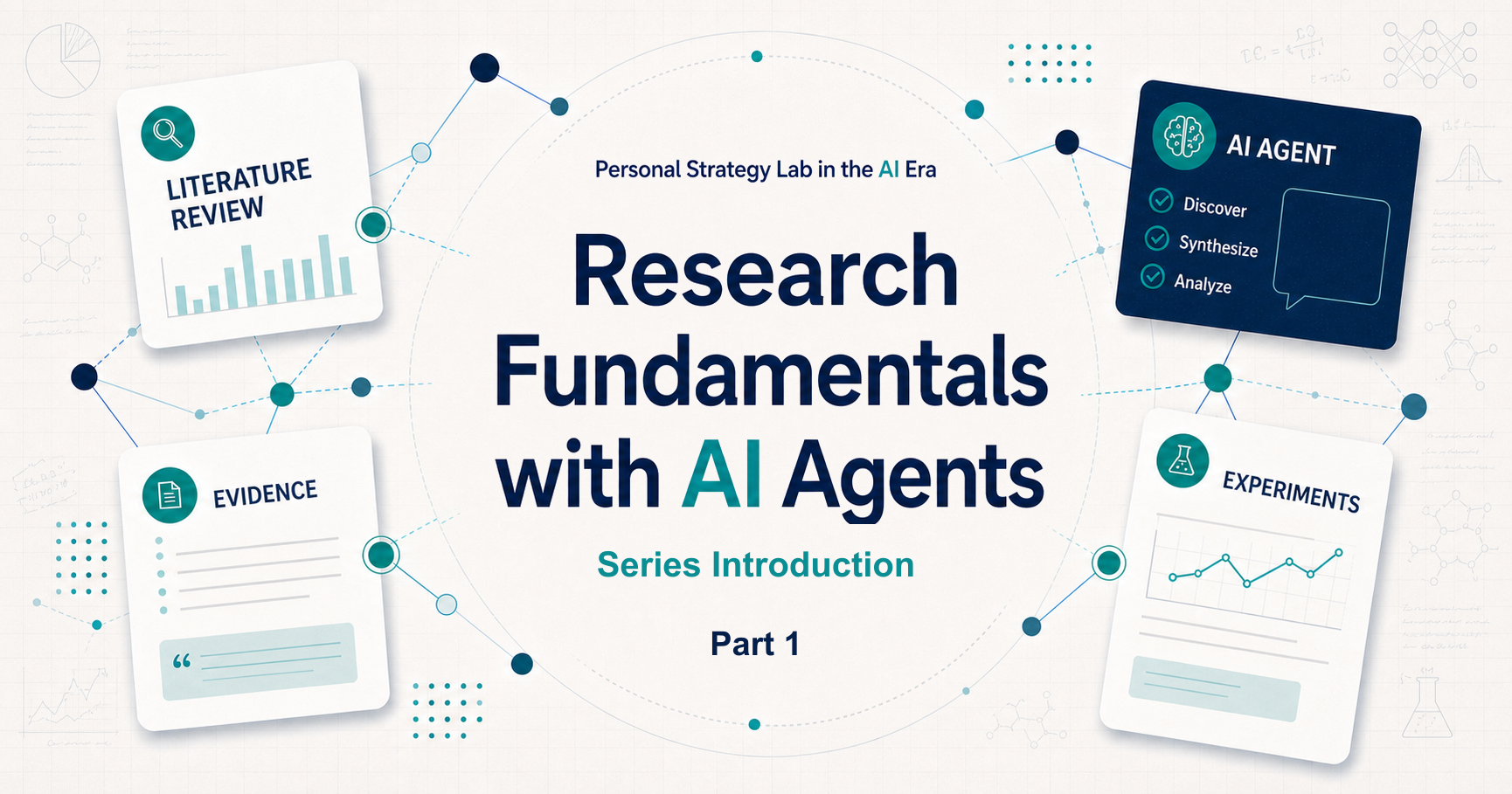
Research does not begin with a method or an experiment. It begins by identifying social and technical problems. In this series, a technical problem is what current knowledge, techniques, and approaches still lack in order to address a social problem. I see research as determining what is necessary and building an answer from evidence.
In Japan, many fourth-year undergraduate students in science and engineering complete a graduation research project as part of their degree. In this series, I share lessons about research practice that I learned through trial and error during my own project, along with the basics of using AI agents as research assistants. It is for people starting their first research project, people who have become stuck partway through one, and people considering how to use generative AI in research.
What this series aims to help you do
By the end of this series, I hope you will be able to:
- See research not as trying methods, but as building the evidence needed to address a problem.
- Connect social problems, technical problems, research questions, and the requirements a method must satisfy.
- Treat literature reviews, empirical work, note-taking, and discussion as parts of one coherent process.
- Use AI agents critically: checking sources, considering alternatives and blind spots, rather than treating their output as a conclusion.
The ideas in the first half of the series are useful even if you do not use AI. AI agents are not there to do research in your place. They are assistants that can help you pursue research more carefully and efficiently.
I ran experiments before I had understood the problem
At the beginning of my undergraduate thesis, I made an experimental plan and ran a small experiment before I had investigated the problem deeply enough.
The experiment itself ran as planned. But I could not tell whether its results answered the central question of my research. I could not connect the results to that question, and I was no longer sure what I should do next.
Eventually, I went back to clarifying the purpose and the problem of the research. That experience taught me that the first thing to establish is not a method or an experiment, but what needs to be solved and why.
This series is a record of what I learned, in the hope that it helps others avoid some of the same detours.
A brief introduction, and why I am writing this
I am Yuta Kojima, a master’s student in computer science.
When I began my undergraduate thesis, I had very little idea how to conduct research. I gradually learned how to find papers, formulate questions, design experiments, keep records, and discuss my work with an advisor.
Today, I use AI agents to help organize the documents and records that support my research. I do not use them to decide my conclusions. I use them to clarify what I need to think through, locate evidence, reduce blind spots, and preserve the reasoning behind decisions.
This series does not discuss my own research topic or application domain. It focuses instead on research practices and research infrastructure that can be useful across fields.
Research has two cycles
Research is not something you think through once and finish. I find it useful to view research as two nested cycles: a large cycle for one research project and a smaller cycle that repeats throughout day-to-day work.
The large cycle: from starting a project to finishing it
The large cycle starts with an area of interest, develops into a research project, and ends by communicating what was learned and identifying the next question.
- Find an area you can stay engaged with.
- Clarify the social problem and the technical problem.
- Review prior work and distinguish what is known from what is still unknown.
- Define a central question and the necessary conditions for answering it.
- Choose a method and test it through experiments, studies, or analyses on a small scale.
- Analyze the results and determine what the research can support.
- Present or write up the work, then connect the remaining questions to future research.
An undergraduate thesis often involves completing one pass through this large cycle.
The small cycle: repeated investigation and validation
Within the large cycle, you repeat a smaller cycle many times.
- Write down what you do not yet know as a question.
- Form a hypothesis.
- Read papers, investigate, or run a small test.
- Record the facts you obtained and the ideas you developed.
- Interpret the result and update the next question to examine.
Literature reviews, experiments, weekly reports, and conversations with an advisor are all part of this small cycle. Rather than trying to decide on a perfect topic or method at the outset, research tends to move forward when you use this cycle to sharpen your questions.
What this series covers
Part 1: An introduction to the series
This article introduces the series and the large and small cycles of research.
Part 2: Do not start research with a method
Part 2: Research Does Not Start with a Method: How to Frame a Question explains how to formulate a research question from a social problem, a technical problem, and the conditions needed to answer the question. Before looking for a method that might work, it asks why a particular capability is needed.
Part 3: How to find papers when you do not know where to begin
Part 3: How to Find Research Papers: Reviews, Citation Trails, and AI traces a research field through review papers, references, and cited-by papers. Generative AI, including Deep Research tools, can help generate search terms and find candidate papers, while we verify the sources ourselves.
Part 4: Reading research papers with AI summaries
We will use AI summaries to see a paper’s problem, method, experiments, results, and discussion before checking those points in the original paper and relating them to our question.
Part 5: Designing experiments that lead to clear conclusions
We will work backwards from the possible results and conclusions, then check whether an experiment can actually answer the central question.
Part 6: Keeping track of the reasoning behind your research
We will separate the record of our reasoning, our decisions, and our weekly reports. This makes it easier to preserve why a choice was made and to align assumptions with an advisor.
Part 7: Using AI agents as research assistants
We will build a system that connects records and preserves their change history. Specifically, we will use Obsidian (a note-taking app), Git (a system for managing file histories), and relative links (links between files in the same collection) so that both people and AI can trace evidence, decisions, and changes.
Part 8: Avoiding tunnel vision with generative AI
Generative AI can steer a discussion toward a method that looks workable or the last option left on the table. We will examine what is actually required, consider alternatives, and question the assumptions built into a method so that the reasoning does not narrow too quickly.
Part 9: Moving research forward with generative AI
Part 9: Research with Generative AI: From Brainstorming to the Next Question explains how to examine contradictions, counterexamples, and blind spots, then turn a conversation into working notes, provisional decisions, and the next question to investigate.
As future parts are published, this index will link to them.
If you want to use AI agents in research
If you plan to use AI agents continuously for research records, literature searches, brainstorming, and document organization, I believe a subscription is worth serious consideration.
The value is not simply writing faster. AI agents can help you read research materials, gather related evidence, organize your thinking, and surface possible blind spots or counterexamples. That can free up more time for the parts that require your own judgment.
However, generative AI tends to agree too readily with the user. Without careful prompting, it can settle too quickly on a plausible method or explanation and leave alternatives or assumptions insufficiently examined.
Do not treat generative AI output as a conclusion. Check its sources, separate facts from inferences, and judge its proposals against the purpose of the research. With that discipline, generative AI can become a powerful research assistant.